

Industrial AI Operating Platform
Cubeon

Industrial AI Operating Platform
Cubeon
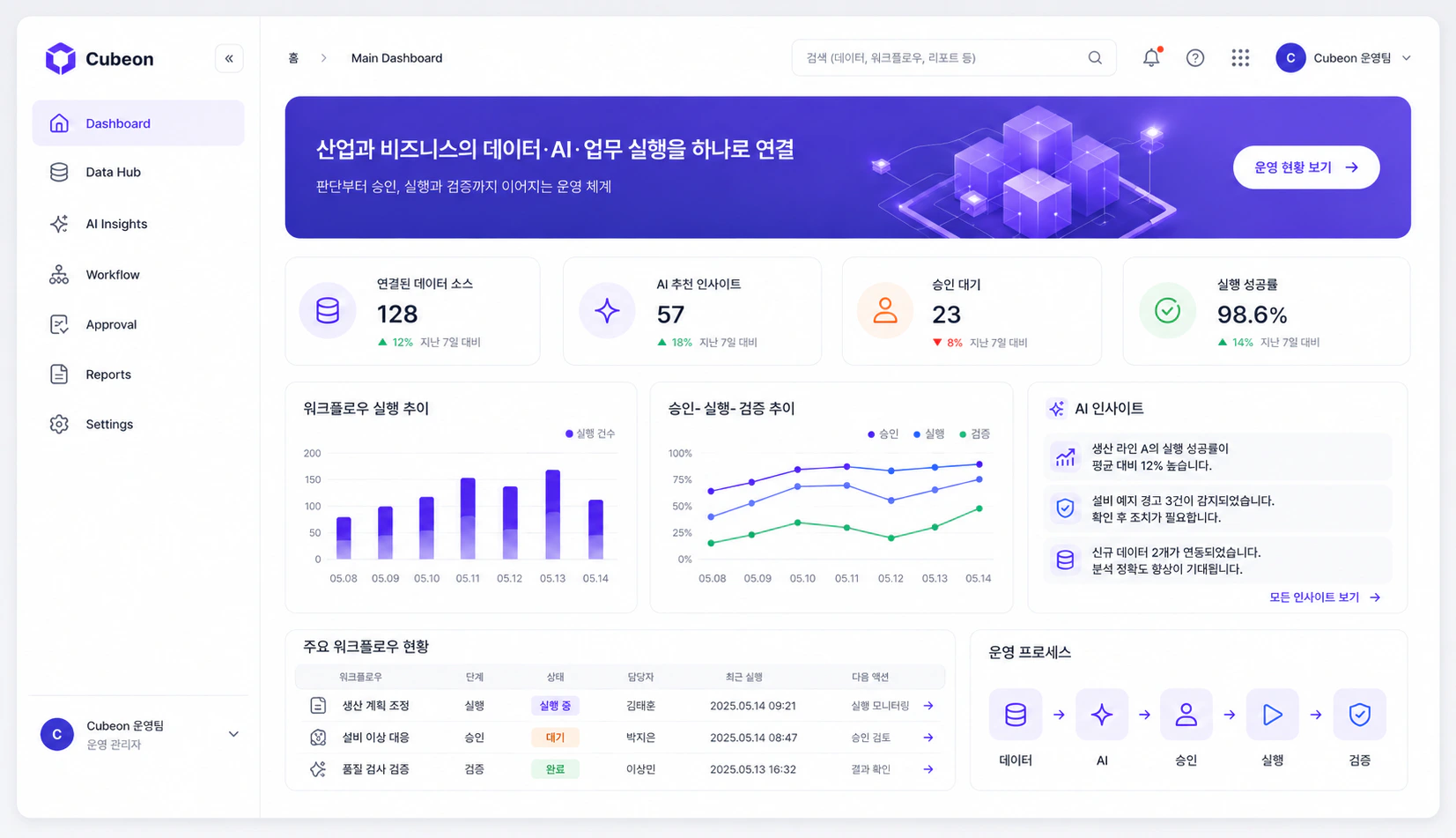
Connect data, AI, and operational execution in one platform— from decisions and approval through action and verification.
Overview
Connect data and AI to the way your organization operates
Cubeon manages data connections, AI models and agents, approvals, execution, and result verification in one platform.

A shared vocabulary
Different names and formats reconciled under shared terms and relationships, so context and meaning line up
Model and agent operations
Manage training, deployment, performance, and access for analytical models and specialist agents
Approval, action, verification
Review evidence, approve actions, execute safely, and verify results and historyFeatures
Six core modules connecting data to execution
Operate knowledge and AI services on a shared data foundation, then execute safely through your approval process.
Unified data management
Connect structured, unstructured, and industrial data and prepare it for reliable AI use.- Source connections
- Standard connectors for systems, equipment, documents, APIs, and sensors
- Data pipelines
- Connect → parse → cleanse → standardize → create datasets
- Quality checks
- Continuously track completeness, consistency, freshness, and validity
AI model operations
Manage the model lifecycle from training and validation through deployment, monitoring, and retraining.- Model registry
- Manage versions, training data, and performance metrics together
- Deployment
- Release validated models safely into operating environments
- Monitoring
- Continuously check data change and prediction quality
Workflow orchestration
Coordinate agents and people in a defined sequence to complete one operational workflow.- Decision synthesis
- Combine agent decisions and recommendations into one flow
- Approval routing
- Route approvals automatically according to risk policy
- Execution
- Send approved results to operating systems
Ontology-based knowledge
Connect meaning, relationships, and context to build an enterprise knowledge system.- Knowledge graph
- Explore classes, entities, and relationships as a graph
- Semantic model
- Manage ontology schemas and property mappings
- Revision history
- Manage ontology versions and domain classifications
Specialist AI agents
Answer questions, analyze documents, and perform tasks within defined permissions.- Grounded answers
- Respond using retrieved documents and data as evidence
- Access awareness
- Separate knowledge and capabilities by role
- Tool connections
- Call business systems and AI tools safely
Unified monitoring and audit
Manage detection, decisions, approvals, execution status, and change history in one console.- Operations
- Track service state, response time, and errors together
- Audit history
- Record models, knowledge, and every execution step
- Recovery
- Restore a verified previous version when problems occur
Architecture
Combine the functions you need with eight shared modules
Start with the modules and domain capabilities you need, then expand the same operating foundation step by step.

Connect
Connects sources that have little in common — controllers (PLC), sensors, manufacturing execution (MES) and enterprise resource planning (ERP).
- Edge collection and recovery — Data held locally when the network drops, sent again once it is back
- Secure connections — Encryption, device authentication and role-based access protect data in transit
Fabric
Streaming and scheduled data alike, stored, cleansed and delivered without drama.
- Operational visibility — Latency and error rates measured at every stage, from collection to control, to find where it hurts
- Scaling in steps — The same proven structure reused, from one line to the whole company
Semantic
A shared data format and an ontology of terms and relationships bring names and meanings into line.
- Consistent quality — One format, quality checks and gap filling leave the data fit to analyse
- Search by relationship — Follow the links between data, documents and work to find what you need
ModelOps
Training, validation and deployment history are kept, accuracy is watched in service, and the model is retrained when it needs to be.
- Detecting change — Shifts in input data and predictions signal when to retrain
- Audit trail — Every judgement and action recorded, ready for quality and regulatory questions
Agents
Agents that answer questions, read documents and get work done.
- Grounded answers — Answers built on the documents and data found, with the sources kept
- Permission aware — Role-based access decides which knowledge and functions each person can reach
Orchestrator
Several agents, each with its role and turn, brought together to finish one piece of work.
- Bringing judgements together — What each agent concludes and recommends, merged into a single flow
- Approval branching — Risk and reversibility decide which approval path an action takes
Console
Detection, judgement and execution, managed on one screen.
- One operations dashboard — Service health, response time, throughput, errors and work in progress, all in one view
- Change and rollback — Changes to models, knowledge and settings are recorded, and an earlier version can be restored
Copilot
Choose what answers the questions — a commercial large language model, or a small one running in-house.
- Deployment choice — A commercial AI service, an in-house build, or a network cut off from the internet — whichever the rules require
- A fixed data boundary — Policy fixes where restricted data is processed, so it never crosses the line
Product Structure
Extend domain capabilities on a shared core
Reuse the common foundation for data, AI, and execution, then add the domain packs and copilots required for each challenge.
Shared operating foundation
Horizontal Core
Combine eight modules from Connect through Console to establish shared standards for data, AI operations, approval, and execution.Manufacturing domain pack
Manufacturing Pack
Apply anomaly detection, predictive maintenance, quality prediction, process optimization, and energy optimization to manufacturing.Safety domain pack
Safety Pack
Analyze video, sensors, and operational events together to identify risk and provide evidence and response priorities.Knowledge service
Copilot
Answer questions from enterprise documents and data, explain results, and support the follow-up work that people need.Operating Levels
Automate gradually within verified boundaries
Start with detection and alerts, add human approval, and expand toward controlled automated execution.
Detect
Collect data, understand state, detect anomalies, and alert
Decide
Analyze causes, recommend action, and obtain approval
Act
Execute within approved boundaries, verify, and improve
Deployment
Deploy to meet data and security requirements
Choose edge processing, on-premise deployment, or a hybrid model connecting private and cloud systems.
Edge
Process near equipment to minimize latency and external data transfer
On-Premise
Operate sensitive data and AI models inside the organization’s security boundary
Hybrid
Divide roles across edge, private systems, and cloud for security and scalabilityIdeal Use Cases
It suits organisations like these
For organisations that want scattered data and AI services brought under one operating standard — and carried through to action.
AI initiatives are fragmented across teams
Teams run data and models differently and need shared standards and reusable structuresAI results do not lead to operational action
Analysis exists, but approval, follow-up action, and result verification are not connectedCritical decisions require human confirmation
Safety, quality, and cost decisions require evidence and final approval by accountable people